Sunday, October 31, 2010

Ghana IV- The Coast

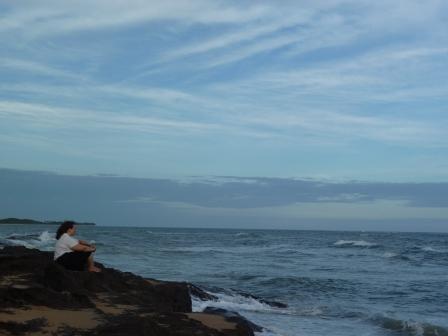
Enjoying the Beach
Molly on the beach.

Ryan on the beach.

From Kumasi we traveled back down to the coast on the bus. We stayed in a small fishing village called Ampenyi, where we spent our first day just relaxing on the beach, swimming in the ocean, and watching the local fishermen work in their boats made from hollowed-out tree stumps and adorned with bright colors and traditional symbols called Adinkra.

We very much enjoyed the place we stayed--Ko-Sa Beach resort--and would recommend it if you happen to find yourself planning a trip to Ghana. The beaches there were very quiet and isolated, and we found many interesting shells and stones. The place is owned by a Dutch couple, who have been doing renovations/updates, especially the open-air restaurant and common area with book-swap library and many games. Unfortunately for us, the books and most of the games were in Dutch or German! We found one game to play though--UNO!

Our hut. Ryan is standing with Ralph, a science teacher at the local school in Ampenyi. He owns a taxi, in which his brother, Simon drove us around to the local attractions.

Grilled lobster and chips. Quite possibly our favorite meal in Ghana.

The view from our breakfast table. The two smaller figures which look like small palm trees are actally women carrying palm branches on their heads down the beach!


Castles from the Slave-trade
Our second day on the coast we visited Cape Coast Castle in Cape Coast and St. George Castle in Elmina, where the British and Dutch, respectively, had their main bases in the trans-Atlantic slave trade. Our time at the castles was emotionally intense and disturbing, as we were given the opportunity to enter into the slave dungeons where thousands of human beings were kept for months on end without light, ventilation, or sanitation, and with very little food and water. The beauty of the castles’ natural surroundings—white sand beaches, crystal blue waters, palm trees swaying in the breeze—was a stark and disturbing contrast to the ugliness of their history.

Cape Coast Castle
Cape Coast Castle.


It was a hot, sunny day at Cape Coast Castle. Is it wrong to smile in this place?


Inside one of the slave dungeons, with no lights, and the door shut.


View from one of the upper rooms of the castle, a dining or meeting hall.


The "Door of No Return." Slaves exited this door to board the ships. This was their last glimpse of Africa.


Cape Coast, as seen from the castle.


A view from Cape Coast Castle.


A view from Cape Coast Castle.

St. George's Castle, Elmina
St. George's Castle from the road.


Interior courtyard of St. George's Castle.

We learned of a telling spacial heirarchy: Ground floor--Slaves dungeons (originally built for storing goods), First floor--small rooms for sailors, ministers, merchants, Second floor--Deputy Governor's quarters, Third floor--Governor's quarters (directly above female slave dungeon & courtyard).

The Condemned Cell.

Left door: Condemned Cell--for slaves who rebelled or tried to organize revolt. The cell has no window. They were given no food or water, and didn't come out of the cell alive.
Right door: Cell to punish rebellious soldiers. This cell had two windows for ventilation. They were fed. And released.

Stairway from female slave dungeon to Governor's bedroom.


Trap door from female slave dungeon to Governor's bedroom.

This stairway and trap door led directly from the courtyard outside the female slave dungeon to the Governor's bedroom. The Governor would come out on his balcony overlooking the courtyard and select a woman who would then be cleaned up and sent up the stairs to him.

The "Door of No Return" at St. George's Castle. Very short and narrow.


A view of St. George's castle.


Double Moats used to be filled with water, outside St. George's castle.

Entrance/Exit from St. George's Castle.


Simon! Our taxi driver for the day. He was very knowledgeable of the castles, especially St. George's Castle.


Kokrobite Fishing Village
We spent our final two days in Kokrobite, a fishing village on the beach just outside Accra, and within driving distance to the airport. The beach was very busy--with Rasta stands selling all sorts of clothing, jewelery and other traditional arts and crafts, alongside active fishing boats.

The beach at Kokrobite.

Beach-side stand with local jewelery and arts and crafts.


Fishing boats on the beach.


A fishing boat out at sea.


Fishing boat landing on the beach.


Men and boys on the shore rush over and help to pull in the boat.


One man (in yellow) pushes the boat, while others pull.


The boat is rolled up the beach using two flat boards, across which a thin log is placed, on which the boat rolls.


Local women buy fresh fish right off the boat.


Off the women go, while the fisherman carefully untangle their nets.


Ryan lounges with a cool drink, reading his kindle.

Thursday, October 28, 2010

Ghana III--Kumasi, the Asante Capital

We flew to Kumasi, the Asante Capital, in a small prop plane--with 18 seats. This is a picture of Ghana's coast from the plane.

While in Kumasi, we visited the Manhyia Palace Museum (no pictures allowed) and spent a day at the cultural center where artisans were creating their arts and crafts in the open air (kente cloth, batik fabric, drums, paintings, pottery, baskets and jewelry).

While in Kumasi, we tried eating fufu, a Ghanaian traditional staple food, made of pounded and boiled cassava or yams, but we weren’t too keen on it. We much prefer Zambian nshima (made of corn meal or "mealie meal")! We did find some food we enjoyed--especially Jollof Rice, which is like a Ghanaian-style fried rice with tomato and chile seasonings.


a busy street in Kumasi at twilight

The Presbyterian Guest House in Kumasi, where we stayed.

The hallway of the guest house.

The entrance to the cultural center.

Artisans working outside at the cultural center.

Small wax figurines will be cast in plaster, then melted out and filled with molten brass to make brass weights.

Batik cloth drying on the lawn.

Ryan with our newly acquired djembe drum (on his back) and it's maker.

Molly drinking a sachet of water--much cheaper than a bottle. Just rip and suck!

A truck carrying a huge load of the above-mentioned water sachets.

Fufu in soup with hunks of goat meat.

Jollof Rice with more goat meat. Ryan really liked the Jollof.

Fried Plantains! The best--we ordered it after the Fufu which we couldn't finish.

We also attended worship at the Presbyterian Church of Ghana, Adum Congregation Kumasi. It was right across the street from the Presbyterian Guest House where we stayed. Molly wore her clergy shirt and collar (one of the only clean shirts she had). Ryan wore a Daishiki and shorts and his Birkenstocks (he forgot to pack his clergy shirt). So Molly got us an all-access pass to sit in the very front of the congregation--which was a really interesting view point. Many people in Ghana, especially the men, now wear the traditional cloth--slung across one shoulder. You can see the men in cloth if you look closely at the photos in the church. Fortunately we weren't asked to preach!

Presbyterian Church of Ghana, Adum Congregation, Kumasi.

A view of the congregation: the choir on the top level--along with a brass band, organ, synthesizers, drum set and traditional drums.

Offering--they have huge 3-tiered golden buckets for each side ("tithe," "offering 1," & "offering 2") PLUS a brass bowl for a special offering because it was Education Sunday.

A funny "health tip" on the big screen at the front of the church.

Ghana II- Accra

While we were in Accra for the conference, there was one “outing day” in which we went with some others into downtown Accra. We visited the National Museum, the Kwame Nkrumah Memorial Park, and the Presbyterian bookshop where Molly purchased some Ghanaian literature to read and get a deeper sense of the Ghana while in country.

Kwame Nkrumah Memorial Park (Nkrumah was the first president of Ghana, and Pan-Africanist philosopher and leader).

Statue of Nkrumah, in front of the Memorial--which actually houses his grave.

An older statue of Nkrumah which used to be in another part of the city, but was be-headed during a riot. It's now in the memorial park.

A garden full of Nkrumah's book jackets in the park.

The Golden Jubilee House, it was built as the Presidential Palace (residence & office). The former president, John Kufuor, used it, but the current president, John Atta Mills, had opposed the $30 mill loan from India to build it, so he has refused to use it since his presidency.

The national museum in Accra.

Traditional Asante stools--used for royalty, ritual ceremonies, or everyday household uses.

Kente cloth on a loom.

An awesome xylophone--with gourds underneath as the resonators!

Agricultural tools--Grandpa Ed, can you imagine using these to plow a field?

Kwame Nkrumah's chair.

Tuck shops painted in the colors of Ghana's flag.

"God First Fast Food"--lots of creative names for the shops in Ghana.

Accra as seen from the roadside.

A roadside scene in Accra. Molly LOVES goats!

Thursday, October 21, 2010

Zimbabwe!!

We were just unexpectedly invited to join the MAPC delegation on their trip to Zimbabwe this week. It didn't originally occur to either party that it was a possibility, but as they will be so close, and as work is extremely slow here right now... Ryan and I started scheming to go down and rendezvous with them at Victoria Falls... then Fred invited us to come along for the whole trip, from Harare to Bulawayo to Gweru then to Victoria Falls ...and with permission granted from the TEEZ Director, we are now looking for tickets...!

Zim here we come!

Don't worry parents, it is safe, and we will be with the MAPC group. :)

More entries on Ghana will be forth-coming as soon as we can. Please pray for us as we get packed and travel.

Tuesday, October 19, 2010

Ghana- AATEEA Conference

All-Africa Theological Education by Extension Association Conference.
Theme: Mobilizing all God's People for Human Transformation and Ecological Restoration: The Role of TEE.

The conference was a great success, with representatives from 20 countries (South Africa, Botswana, Zambia, Malawi, Zimbabwe, Angola, Mozambique, Madagascar, Mauritius, Tanzania, D.R.Congo, Rwanda, Kenya, Sudan, Benin, Togo, Ghana, Liberia, Sierra Leone, and The Gambia). There were also a few guests and presenters who came from the UK, Germany and the USA.

During the week, we worshiped together, shared fellowship at meals, heard reports from each country's TEE program, attended workshops on the ecological challenge, human rights & gender justice, creating TEE materials, and curriculum to address HIV and AIDS, among others.


The main conference room.

The delegate from Angola making a report on the TEE in his country.
While it looks as if Kangwa is using three computers--small, medium and large (!).

The new website was "unveiled" and Ryan demonstrated how to navigate it.

We also had the chance to worship in local churches in the Accra area. We attended an indigenous Orthodox Church in Accra. They began as an independent indigenous church during the Ghanaian independence movement. they used the word "Orthodox" in the name of their church, without knowing of the Eastern Orthodox tradition. Then one of their youth leaders came across a book in the University of Ghana bookstore on the Orthodox church and circulated it among church leaders. A year later, the World Council of Churches was having its annual meeting in Accra, and the church leaders met Eastern Orthodox bishops for the first time. Shortly thereafter, they began the process to be received into the Eastern Orthodox Church, under the Patriarchate of Alexandria. For a more complete history of the Orthodox Church in Ghana, see here.

An indigenous Orthodox church in Accra, with whom we worshiped on Oct 3.

The conference was held at the Forest Hotel in Dodowa, a "suburb" just outside Accra. The amenities were quite nice, with a restaurant, pool, bar, air-conditioning, and a conference center area with several rooms. We ate in the restaurant every meal, enjoying the chance for less-formal engagement with the delegates and presenters. They served us huge portions--the plates were the size of serving platters, and there was usually both chicken and fish, a large mound of rice, vegetable dishes, and always fresh fruit for desert. We found Ghanaian food to be much more spicy than Zambian, and in fact our Zambian friends, and some of the other delegates, found it too spicy. Not us! (more on food in a future post). We also greatly appreciated the AC, since it was very hot and humid. We only swam in the pool once though, because we were usually too tired after 12 or so hours of meetings and workshops. After our free day, which we went with some others into Accra, swimming was the perfect end (more on Accra in a future post).

The Forest Hotel in Dodowa, just outside Accra, Ghana.

Enjoying the swimming pool at the hotel.